
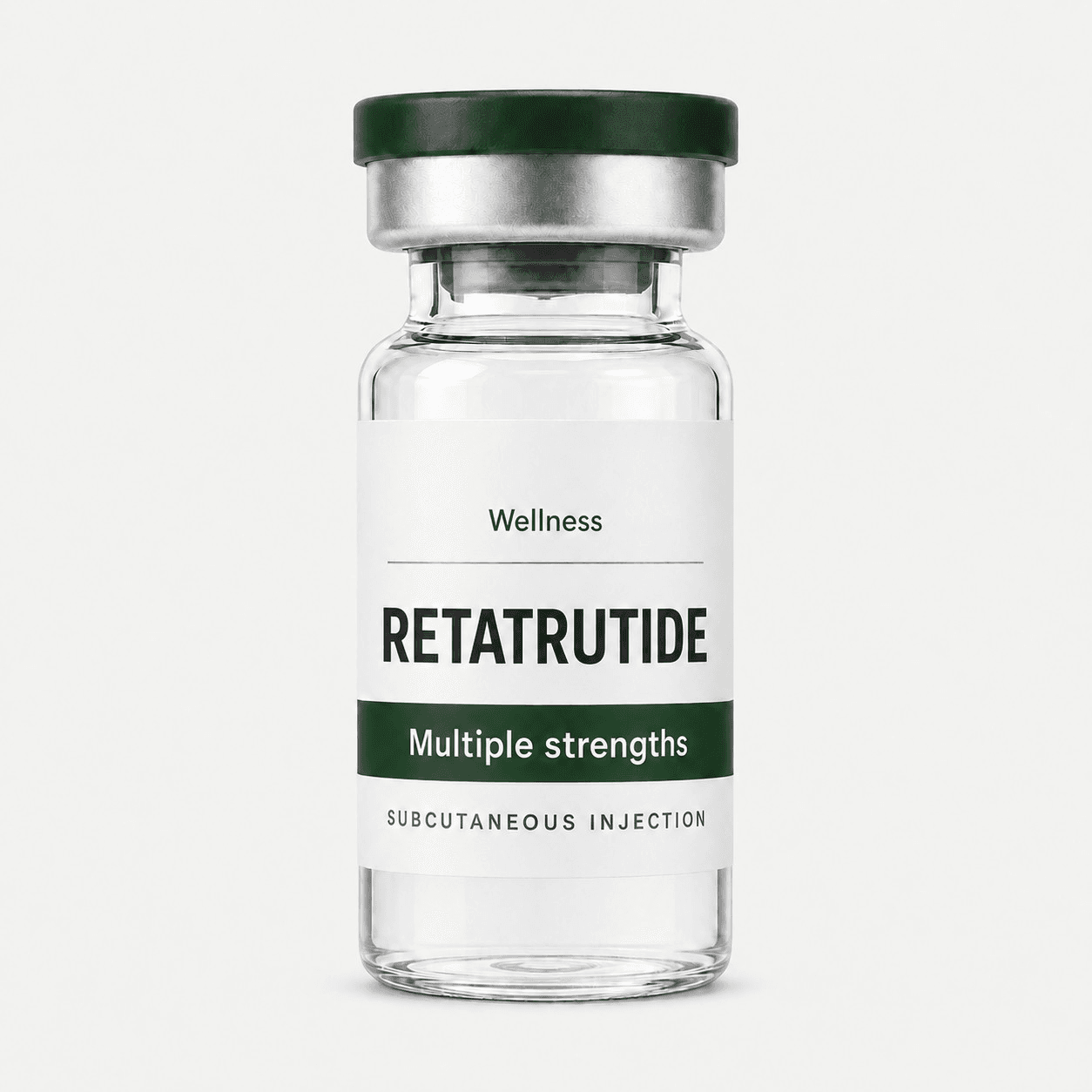

Retatrutide
An investigational triple-pathway (GLP-1/GIP/glucagon) agonist still in clinical trials — not FDA-approved for any use. Whether it's an appropriate option is strictly a physician's call.
| Concentration | 1–8 mg/0.5 mL (2 mL vial) |
Available strengths
- 1 mg/0.5 mL · 4 mg
- 2 mg/0.5 mL · 8 mg
- 4 mg/0.5 mL · 16 mg
- 8 mg/0.5 mL · 32 mg
Your physician determines the appropriate strength and titration.
Member pricing
Create a free account to see your all-in price for this therapy — and exactly how it compares to other clinics.
About Retatrutide
The honest rundown
Straight information, no hype — so your conversation with a physician starts from the truth.
Retatrutide is a triple receptor agonist — a single molecule designed to engage the GLP-1, GIP, and glucagon pathways at once. In mid-stage human trials it has drawn attention in obesity research, and late-stage (phase 3) trials are still underway.
Here's the part we want you to read first: retatrutide is investigational. Unlike semaglutide or tirzepatide, it has no FDA-approved version for any condition, anywhere. The version available through TCO programs is prepared by the partner 503A pharmacy, and whether it's a defensible option for you — versus an approved alternative — is a conversation your physician will have with you honestly, including the unknowns.
How it works
What the science actually looks at
GLP-1 pathway
Like other GLP-1 agonists, it acts on receptors tied to satiety and hunger signaling.
GIP pathway
It engages GIP receptors, the second pathway studied in dual agonists like tirzepatide.
Glucagon pathway
The third target — researchers are studying its role in energy expenditure, which is what makes the molecule notable.
Trial status
Mid-stage trial results have been published; phase 3 trials are ongoing and long-term data does not yet exist.
Who it's for
Who tends to look into this
- People who've discussed approved GLP-1 options with a physician first
- Those comfortable with an investigational therapy and its unknowns
- Candidates ready for closer physician oversight, not a casual trial
- Anyone pairing therapy with the nutrition and coaching that do the durable work
The approach
Possible duration & dosing
Duration
A physician-supervised therapy reviewed continuously — never open-ended or self-directed.
How it's given
A once-weekly subcutaneous injection.
Your dose
Your physician starts low and steps up gradually, and may prefer an approved alternative first. The plan is theirs to set — never self-adjusted.
With every order
What's included
- A consultation with our physician-led team
- A doctor-reviewed medical history and a plan personalized to you
- Temperature-controlled shipping with tracking on every order
- Complete supplies — syringes, alcohol wipes, and clear instructions
- TCO Wellness supports you with messaging access and new orders
Realistic view
Possible expectations
The honest baseline
Published results come from mid-stage trials, not completed phase 3 programs. Early data is promising to researchers but is not proof, and it's no promise for any one person.
Early weeks
As with other incretin therapies, reduced appetite is the commonly reported early signal, with digestive side effects possible alongside it.
Over the months
Any body-composition change unfolds over months under continuous physician review — and lifestyle still does much of the work.
Keeping it right
Storage & handling
- Keep it cool and out of direct light — refrigerate unless your instructions say otherwise
- Follow the storage and handling directions that ship with your order
- If anything looks off — cloudy, discolored, or past date — check with your provider before using
- Dispose of any needles and syringes in a proper sharps container
Questions
Common questions
Is retatrutide FDA-approved?
No — for anything. It's an investigational molecule in ongoing clinical trials, and the compounded version here is likewise not FDA-reviewed. That's a real difference from semaglutide and tirzepatide, whose actives are approved.
Why consider it over an approved GLP-1?
That's precisely the question for your physician — and they may well recommend an approved option instead. The honest answer is that approved alternatives carry far more complete evidence.
What about side effects?
Digestive effects are the most commonly reported in trials, and because the molecule is investigational, its long-term profile is still being studied. Your physician walks through what is and isn't known.
How is it taken?
A once-weekly subcutaneous injection at a physician-set dose. Syringes, alcohol wipes, and instructions ship with every order.
Before you ask
Worth knowing
- Investigational: no FDA-approved version exists for any use, and long-term safety data is still being collected.
- Not for use in pregnancy, or with a personal or family history of medullary thyroid cancer or MEN2 — tell your physician.
- Expect your physician to discuss approved alternatives first; prescribing it is their independent decision.
- Dosing steps up gradually and is owned by your provider, never self-managed.
How it's made
Quality & compliance
- Prescribed only by an independent licensed physician after reviewing your medical history
- Compounded and dispensed by a state-licensed 503A compounding pharmacy
- Prepared patient-specific — compounded medications are not FDA-approved products
- Backed by coaching and concierge support the whole way through
Educational information only — not medical advice, and not a claim of results. Whether any therapy is right for you, and at what dose, is determined solely by an independent licensed physician after reviewing your medical history.
How it works at TCO
No therapy is a product you simply buy
An independent licensed physician reviews your history and determines whether therapy is appropriate. Want to talk it through with the doctor directly? We'll set that up.If approved, your order is fulfilled by a state-licensed 503A compounding pharmacy with temperature-controlled shipping and every supply included — and you're coached throughout your journey.
Prescription products require an evaluation with a licensed medical professional, who will determine whether a prescription is appropriate. Compounded medications are prepared by a state-licensed 503A compounding pharmacy and are not FDA-approved; the FDA does not review compounded medications for safety or effectiveness.
TCO Wellness is a wellness and concierge-care company — we do not practice medicine. All prescriptions are issued by independent licensed physicians after review of your medical history, and medications are compounded and dispensed by a state-licensed 503A compounding pharmacy. Individual results vary.